
The floods underscored what many communities already knew: piecemeal funding, snail-pace permitting systems, and continued development in high-risk areas leave people and infrastructure vulnerable. At the same time, our network is stronger and more prepared than ever.
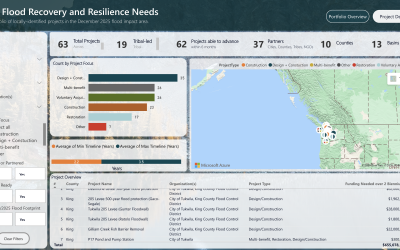
Across the state, more than 60 community-supported flood recovery and resilience projects are ready to move. These projects reflect years of planning and design. They align with local flood hazard mitigation plans, flood resilience strategies, and species recovery goals. Many are prepared to begin scoping or contracting within the year.
The opportunity before us is to act at scale, addressing immediate recovery needs while also fixing the systemic barriers that keep us stuck in a cycle of damage and repair. This initiative centers on four connected strategies:
1. Fund Immediate Needs
Communities have identified strong projects across King, Whatcom, Pierce, Snohomish, Yakima, Skagit, Clark, Clallam, and other regions. These include:
– Levee setbacks and improvements
– Floodplain reconnection and flood storage
– Habitat restoration with flood risk reduction benefits
– Voluntary buyouts and acquisitions to move people and infrastructure out of harm’s way
– Critical infrastructure relocations
2. Stop the Problem
Resilience is not only about responding to disasters. It is about preventing future losses. This strategy focuses on:
– Establishing a strategic, voluntary property acquisition approach to move people and infrastructure out of high-risk floodplains
– Redirecting growth to safer areas through smart zoning, incentives, and infrastructure alignment
– Expanding relocation support for manufactured and mobile homes Increasing transparency around flood risk for buyers, renters, and property owners
– Advancing tools like Transfer of Development Rights (TDR) and updated Channel Migration Zone (CMZ) mapping
– Exploring a state-led home elevation program
3. Speed Solutions by Transforming Permitting
Even well-designed, fully funded projects can stall in complex permitting systems. Delays increase costs, reduce project benefits, and erode public confidence. The initiative proposes practical steps to streamline delivery, including:
– Increasing state capacity to partner with FEMA on map revisions
– Investing in updated and expedited floodplain mapping
– Eliminating duplicative reviews through joint technical teams
– Expanding fast-track pathways for public-benefit flood resilience projects
– Aligning state and federal forms and processes
– Strengthening tribal co-management partnerships
– Creating a unified online portal for single-submission permit tracking and public transparency
4. Build Capacity Through Knowledge Infrastructure
Flood resilience depends on people, data, and shared expertise. Across the state, floodplain managers face high turnover and uneven capacity. The initiative calls for:
– Career development and mentoring support for floodplain professionals
– A shared project database to support peer learning
– A Pacific Northwest–specific technical library for design standards and modeling
– A stronger community of practice across jurisdictions and sectors
– Modernized, digitized data systems to inform planning and risk management
– Innovative project delivery tools that reduce administrative burden and improve outcomes
A NOTE ON INTEGRATED FLOODPLAIN MANAGEMENT:
Integrated Floodplain Management (IFM) represents hundreds of professionals from Tribes, local governments, nonprofits, and the private sector. Unlike a decade ago, many watersheds now have system-scale, broadly supported visions for how to reduce risk while supporting habitat, agriculture, and local economies. We are not starting from zero. IFM has plans. There are hundreds of projects and partnerships. Needed now is alignment and momentum.
As Floodplains by Design shares this vision across the integrated floodplain management network, our aim is to socialize a clear, coordinated path forward. One that addresses immediate resilience needs while reshaping how Washington manages flood risk.