As December 2025 flood events impacted river systems across the state, Swan Creek offers a clear example of how floodplain investments reduce long-term risks. Flood resilience comes from restoring river processes and not just building stronger barriers. By giving water room to slow down and sediment a place to settle, this project helps protect downstream areas and supports healthier river function without the need for constant emergency repairs.
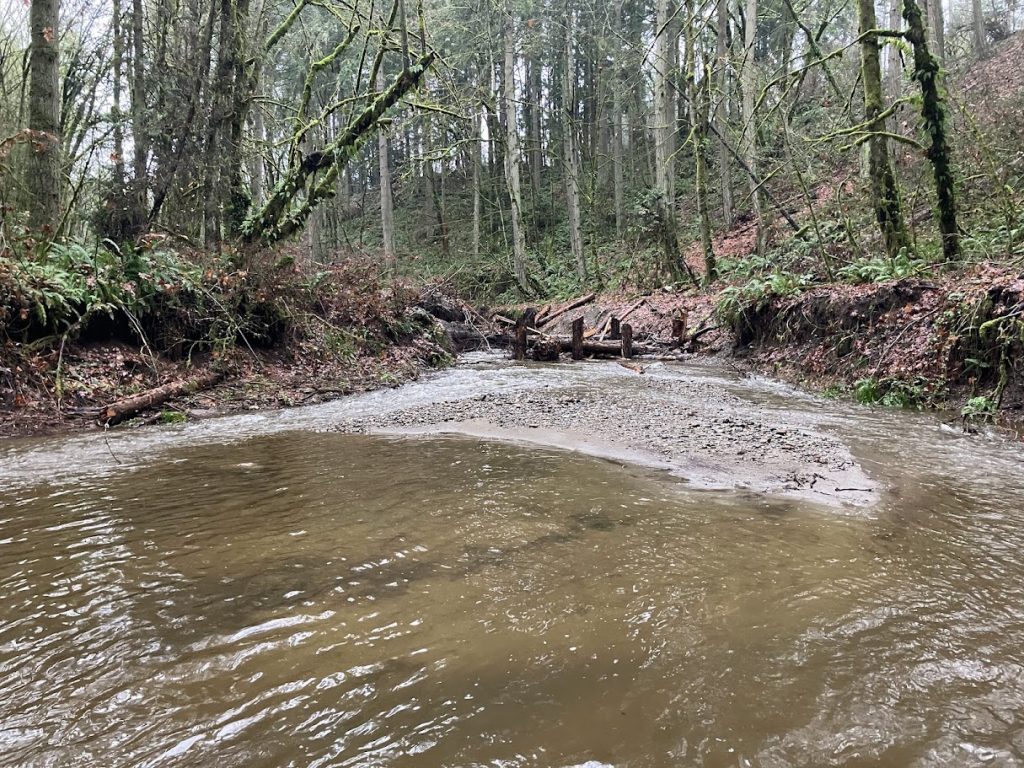
Swan Creek is an important tributary to the Puyallup River that runs through a semi-urban greenbelt and public park system. Decades of upstream development and altered hydrology left the creek deeply incised, unstable, and carrying excessive sediment downstream. Prior to construction, increasing flood events only accelerated the damage, threatening habitat, water quality, and nearby infrastructure.

As much of the work occurred in a steep ravine within an urban park, helicopters were used to place large wood into remote sections of the creek. It was a complex, multi-year effort designed with one reality in mind: floods will keep coming. With support from Floodplains by Design, Pierce County partnered with the Puyallup Tribe of Indians, NOAA, park agencies, and Natural Systems Design to rethink how the creek functions during high flows.
Instead of relying on hard infrastructure like culverts or levees, the project focuses on nature-based restoration. Over a two and a half mile reach, crews installed roughly 60 engineered log jams, using several design types tailored to different channel conditions that flex, shift, and interact with sediment. These structures act like large “catcher’s mitts,” slowing water during floods, capturing sediment, and helping the channel rebuild its natural grade over time. In steeper, erosion-prone reaches, logjams stabilize the channel. When looking downstream, they emphasize habitat benefits for salmon.

Construction of this project is divided into two implementation phases, with phase 1 of construction completed in sites 1, 3, 4, and 6. The project’s completion is slated for 2026-2027 after the second phase of construction is complete in sites 2 and 5.